MudRunner Mobile: The Ultimate Off-Road Game Guide
⚡ Key Takeaways
- MudRunner Mobile is a hardcore off-road truck simulator — not an arcade racer — built around patience, planning, and realistic terrain physics.
- The game features 16 distinct all-terrain vehicles, each with genuinely different weight, torque, and handling characteristics.
- Terrain deformation physics mean the ground actually changes beneath your wheels the more you drive over it — a rare level of simulation depth on mobile.
- The winch recovery system is not a gimmick — it’s a core survival mechanic you’ll rely on constantly.
- With sandbox maps, challenge missions, and a day-night cycle, no two sessions ever feel quite the same.
Table of Contents
- What MudRunner Mobile Actually Is
- Why Slow Gameplay Feels So Satisfying
- The Physics Engine That Changes Everything
- Choosing the Right Truck for the Right Job
- Maps, Terrain, and the Art of Getting Humbled
- Mastering the Winch — Your Lifeline in the Wild
- Tips Every Beginner Needs Before Their First Session
- Frequently Asked Questions
- Final Thoughts
There’s a specific kind of frustration that MudRunner Mobile players know better than anyone. Your truck is axle-deep in mud. The engine is screaming. Your wheels are spinning backwards instead of forwards. You’re three kilometres from the log station, fuel is dropping, and the sun is about to set on your map. And somehow — somehow — you are having the absolute time of your life.
That contradiction is exactly what makes MudRunner Mobile one of the most compelling driving games ever released on a phone. It shouldn’t work. A slow, deliberate, often punishing truck simulator with no gunfights, no lap times, and no instant respawns has absolutely no business being this addictive. And yet here we are.
If you’ve been curious about it, this is the complete breakdown — what it is, why it works, and why it will get under your skin in the best possible way.
What MudRunner Mobile Actually Is
Let’s get something out of the way immediately: MudRunner Mobile is not a racing game. It’s not a casual tap-to-drive experience. And it is absolutely nothing like those parking simulators or highway racers that clutter the mobile games charts.
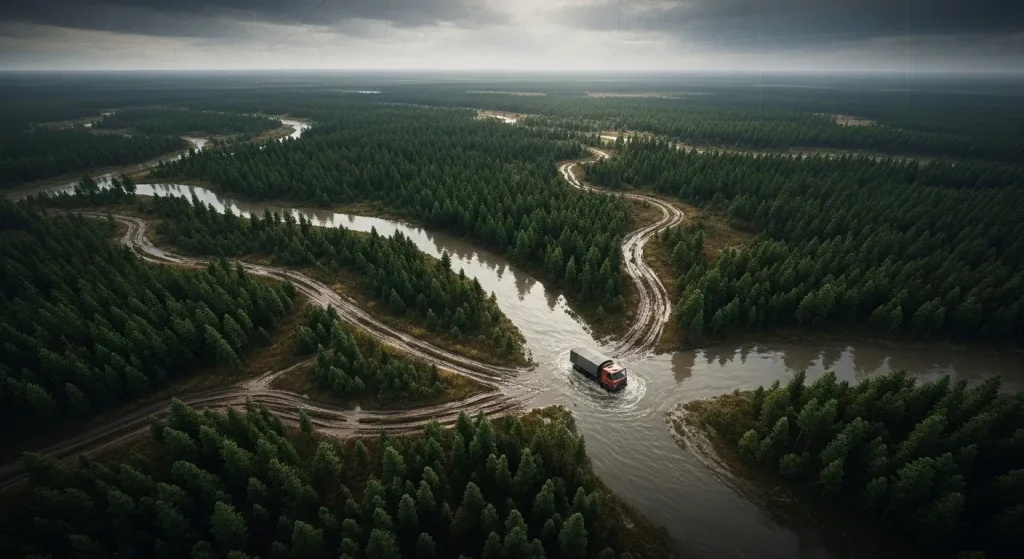
MudRunner Mobile is an off-road truck simulation game set across vast, untamed wilderness environments — dense Siberian forests, flooded river valleys, fog-covered mountain passes. Your job is to pilot heavy all-terrain vehicles through this terrain, complete delivery missions, and get your cargo where it needs to go without drowning your engine, snapping your axle, or burning through your last drop of fuel in the middle of nowhere.
The game draws its DNA from the world of hardcore off-road simulation. It cares about the same things a real off-road driver cares about — ground clearance, approach angles, differential locking, tyre grip on wet surfaces. These aren’t decorative features. They’re the actual mechanics you’ll be thinking about every time you look at a muddy slope and ask yourself whether it’s worth the risk.
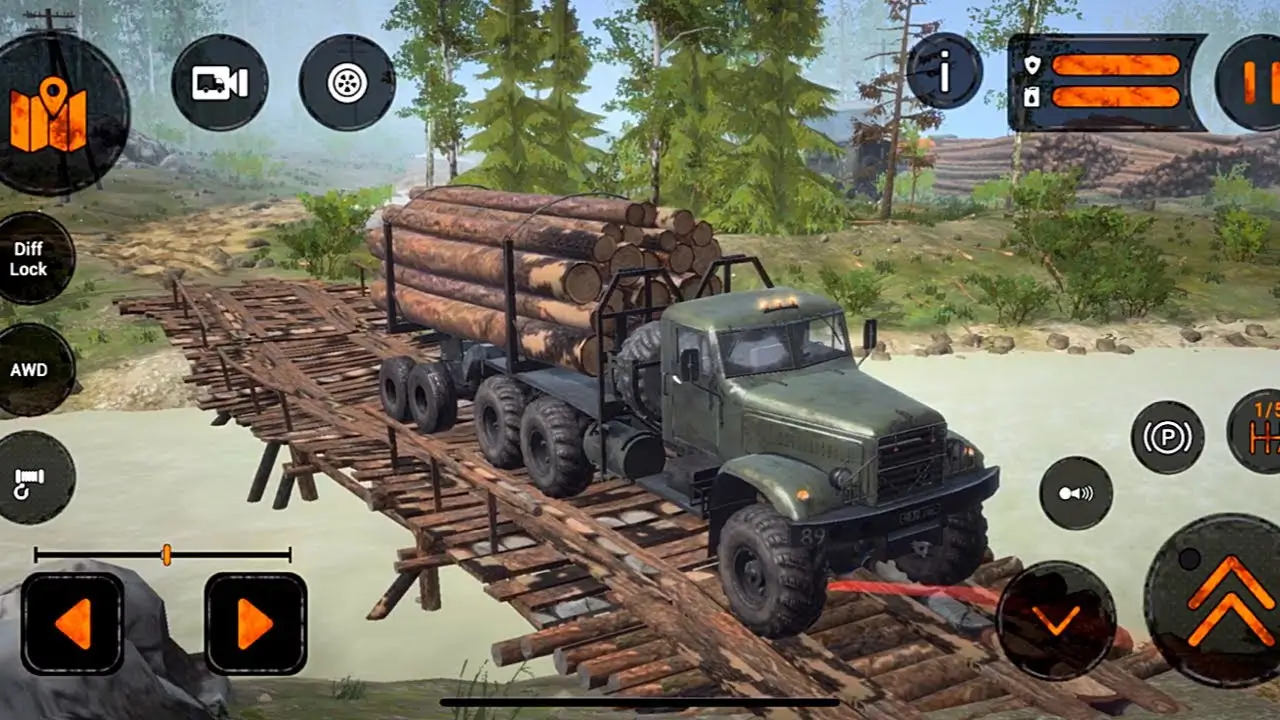
What makes it particularly remarkable as a mobile experience is that it doesn’t simplify itself for the format. The same depth that made the original PC and console version beloved is present here — squeezed into your pocket and fully playable with on-screen touch controls that, after a short adjustment period, feel genuinely intuitive.
Why Slow Gameplay Feels So Satisfying
Here’s a question worth sitting with: why does a game where you sometimes travel at walking pace feel more engaging than games where you’re doing 200km/h?
The answer comes down to consequence. In a fast-paced arcade racer, a mistake costs you a second or two. You spin out, you respawn, you’re immediately back at full speed. The stakes feel low because recovery is instant. MudRunner Mobile flips this completely. Every decision you make has a real cost attached to it.
Taking the shorter route through a flooded ditch might save you five minutes of driving — or it might sink your truck to the chassis and cost you twenty minutes of recovery work. Pushing your heavy hauler up a steep slope without checking the surface first might get you to the top — or send you sliding sideways into a tree line with a full cargo trailer in tow.
That weight of consequence turns even mundane moments into genuinely tense ones. Looking at a river crossing isn’t just a visual experience — it’s a problem you have to actually solve. How deep is the water at the entry point? Is there a shallower crossing upstream? Do you detach the trailer and cross empty first? These are real decisions with real outcomes, and getting them right produces a satisfaction that fast games rarely deliver.
The pacing also creates space for something that mobile games almost never offer — genuine immersion. When you’re crawling at 8km/h through a pine forest in the rain, watching your headlights cut through the dark, listening to your engine strain against the gradient, you’re not playing a game. You’re inside one.
The Physics Engine That Changes Everything
The single biggest reason MudRunner Mobile stands apart from every other driving game on mobile is its physics engine — and specifically, what it does to the ground beneath your wheels.
Most games treat terrain as a static surface. You drive on it, it looks muddy or rocky, and it applies a flat friction penalty to your speed. That’s the entire simulation. MudRunner operates on a completely different level.
The terrain in MudRunner is dynamic and deformable. When you drive through a soft mud patch, your wheels sink into it based on your vehicle’s actual weight. Drive through the same patch again, and it’s softer — because you already disturbed it. Come back with a heavier truck on the same path and the ruts you left earlier will drag that new truck’s axles down deeper than before. The ground remembers what you did to it.
💡 Pro Tip: Never send your cargo truck down a path before scouting it with a light vehicle first. What looks manageable on an empty scout truck becomes a guaranteed stuck situation when you’re hauling a full log trailer behind a ten-tonne Soviet hauler.
This physics model extends to everything — water depth that genuinely varies across a river’s width, snow that compresses differently depending on temperature and shadow, slopes that change traction depending on whether your tyres are spinning or rolling. Engaging your all-wheel drive changes your fuel consumption in real time. Locking your differential gives you traction at the cost of steering precision.
These mechanics aren’t explained through a tutorial prompt. You discover them by getting it wrong — and that process of learning through failure is exactly how the game earns your respect.
Also Read: Caucasus Parking: Why This Game Is So Popular
Choosing the Right Truck for the Right Job
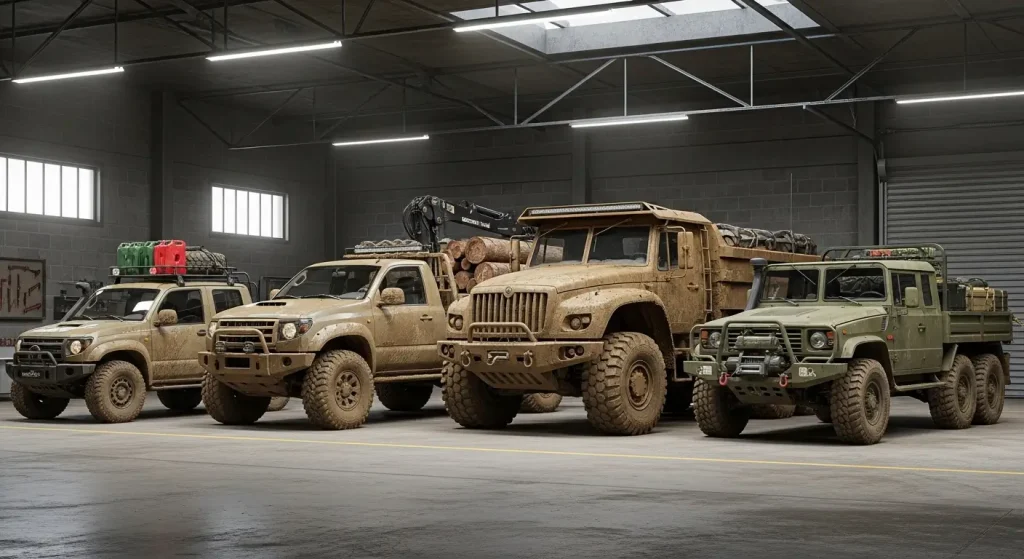
MudRunner Mobile gives you 16 vehicles across its roster, and picking the right one for your mission is genuinely one of the most important decisions in the game. Get it wrong and you’ll spend twice as long fighting terrain that the right truck would have handled without breaking a sweat.
Think of the fleet in three broad categories:
Light Scout Vehicles These are your eyes. Fast, fuel-efficient, and agile enough to squeeze through gaps that would swallow larger trucks. They can’t carry cargo, but that’s not what they’re for. Use them to map your intended route before committing your cargo hauler, identify river crossing depths, and locate fuel canisters or garages on the map. A good scout run at the start of a mission can save you an enormous amount of trouble later.
Mid-Range Work Trucks These are the workhorses. Capable of carrying moderate cargo loads, solid enough to handle varied terrain, and fuel-efficient enough for longer missions. If you’re new to the game and want a truck that will let you progress without punishing you too harshly for mistakes, start here. They’re forgiving without being boring.
Heavy Military Haulers This is where the game gets serious. The heavy Soviet 6×6 trucks in MudRunner Mobile are genuinely impressive machines — almost nothing will stop them once they’re moving in the right direction. They can carry massive log loads, push through terrain depths that would stop a mid-range truck cold, and absorb punishment that would destroy a lighter vehicle.
The cost? They’re slow, they’re thirsty, and when they get stuck — and they will get stuck — they are extraordinarily difficult to recover. An experienced player treats a heavy hauler with careful, deliberate respect. A new player treats one like a bulldozer and inevitably spends forty minutes trying to winch it out of a ravine.
Choose based on what the mission actually demands, not based on which truck looks most impressive in the garage.
Maps, Terrain, and the Art of Getting Humbled
MudRunner Mobile’s maps are not decorative. They’re not pretty backdrops for your driving. They are active obstacles — designed to test every skill you’ve developed and reveal every gap in your knowledge.
The base game includes multiple sandbox environments set primarily across Siberian wilderness terrain. Each map has a distinct geographic character. Some are dominated by lowland river systems — flat, but constantly waterlogged and hiding sinkholes under deceptively shallow-looking water. Others lean into elevation, with steep ridgelines and narrow mountain passes where a small steering error at the wrong moment sends everything sideways.
📌 Quick Fact: In MudRunner Mobile, the same river crossing can be safe in one direction and engine-deep dangerous in the other — because the riverbed slopes laterally. Always cross at an angle that keeps your heaviest side upstream.
The challenge maps take a more structured approach — they present specific scenarios with defined objectives and ramp up in difficulty progressively. They’re excellent for building skills in a focused way before taking those skills into the more open, ambiguous sandbox environments.
What the maps all have in common is that they don’t hold your hand. There’s no GPS arrow telling you the fastest route. There’s no objective marker floating in the air above your destination. You get a top-down map, a compass, and a general sense of where you need to go. The specific path? That’s entirely your problem to figure out.
That design choice sounds harsh, and it is — initially. But once you start reading terrain the way the game teaches you to, once you look at a hillside and automatically assess the drainage pattern and likely mud depth, something changes. You stop feeling like a player who’s being tested. You start feeling like someone who actually knows what they’re doing out there.
Mastering the Winch — Your Lifeline in the Wild
If there is a single skill that separates a MudRunner Mobile beginner from an experienced player, it’s winch technique. Not vehicle selection, not route planning, not throttle control — the winch.
Every truck in the game carries a steel cable winch. In theory, you attach it to a tree or a rock and use the motor tension to pull yourself free of whatever situation you’ve gotten into. In practice, using it effectively is an art form that takes real time to develop.
The most common beginner mistake is attaching the winch cable to whatever anchor is closest. That approach almost always makes things worse — you end up pulling yourself sideways, digging your wheels deeper into the rut, or dragging your front end toward a tree stump at a bad angle. The right approach is to think about the direction of force you actually need, then find an anchor that creates that specific pulling angle.
When you’re buried in deep mud, you don’t just want to go forward — you want to go slightly uphill and forward, creating lift under the chassis as the cable tightens. That means your anchor needs to be above your elevation, not just ahead of it. Finding that anchor, attaching at the right cable length, then combining gentle winch tension with careful throttle input to walk the truck out gradually — that’s the skill. And when it works, when a truck that looked completely finished slowly finds traction and crawls free, it feels extraordinary.
The winch is also useful before you get stuck. Attaching to a tree uphill before crossing a dangerous slope gives you an automatic safety line. If your truck starts sliding, the cable catches it. That kind of preventive use is what experienced players do — they set up recovery options before they need them, not after.
Tips Every Beginner Needs Before Their First Session
MudRunner Mobile has a learning curve — that’s not a criticism, it’s a design feature. But there are a handful of things that will make your early hours significantly less frustrating:
Use a scout vehicle first, always. Before you commit to any route with a cargo truck, drive it first with a light scout. You’ll learn where the deep spots are, where the fuel canisters are hidden, and which paths are genuinely passable before it costs you anything significant.
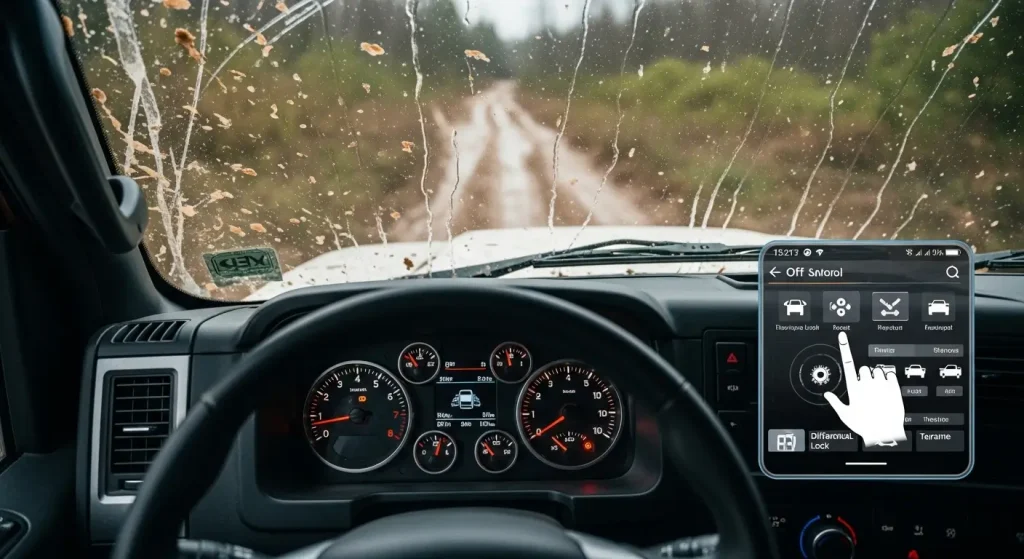
Engage all-wheel drive before you need it. Most new players wait until they’re already stuck to turn on AWD. By then, your wheels are spinning and you’re digging in. Engage it before you enter a suspect section of terrain — it uses more fuel, but far less than a long recovery session.
Slow down on slopes — especially descents. Going downhill fast in a loaded truck is one of the fastest ways to lose control. Shift to low gear before the descent begins, not during. Let the engine do the braking work rather than relying on your brakes alone.
Watch your fuel obsessively. Running out of fuel in the middle of a mission isn’t a dramatic failure moment — it’s a long, quiet humiliation as you sit waiting for a service vehicle that has to crawl across the same terrain you just failed to cross. Always know where the next fuel source is before you need it.
Never ignore your map. The top-down map in MudRunner Mobile contains more useful information than most players ever extract from it. River positions, elevation changes, garage locations, and refuelling points are all visible if you study it carefully before each mission. Two minutes with the map at the start saves twenty minutes of confusion later.
Frequently Asked Questions
Q: What is MudRunner Mobile? A: MudRunner Mobile is an off-road truck simulation game available on Android and iOS. It’s set across wilderness environments — primarily Siberian forests and river terrain — and tasks you with completing log delivery missions using a fleet of 16 all-terrain vehicles. It features realistic mud physics, dynamic terrain deformation, a winch recovery system, and a genuine lack of hand-holding that makes it one of the most authentically challenging simulation experiences on mobile.
Q: Is MudRunner Mobile worth it? A: If you enjoy simulation games and don’t mind a real learning curve, absolutely yes. It offers a level of depth and physical authenticity that virtually no other mobile driving game matches. It’s a paid title rather than free-to-play, which means no energy timers or pay-to-progress frustrations — just a complete, honest game that respects your time and intelligence.
Q: How do you not get stuck in MudRunner Mobile? A: The main strategies are: scout routes with a light vehicle before committing heavy trucks, engage all-wheel drive and differential lock before entering challenging terrain rather than after, use the winch proactively as a safety line on dangerous slopes, and never rush. Most “stuck” situations in MudRunner happen because a player moved faster than their terrain knowledge allowed. Slowing down and reading the ground ahead prevents the majority of recoveries.
Q: What trucks are best in MudRunner Mobile? A: There’s no single best truck — it genuinely depends on the mission. Light scouts are best for exploration and route planning. Mid-range trucks handle most cargo missions efficiently. Heavy military trucks are best for the toughest terrain and largest loads but require more experience to manage effectively. The skill is in matching the vehicle to the specific demands of what you’re trying to accomplish.
Q: Does MudRunner Mobile have multiplayer? A: Yes — MudRunner Mobile supports multiplayer co-op, which is one of the most enjoyable ways to experience it. Coordinating with another player to plan routes, share recovery duties, and winch each other out of bad situations adds a social dimension that makes the game’s challenges feel even more rewarding. Two experienced players working together can accomplish missions that would be extremely difficult — or impossible — solo.
Final Thoughts
MudRunner Mobile is one of those rare games that respects you enough to be genuinely difficult. It doesn’t pad its difficulty with artificial timers or pay walls. It earns it through honest, physics-driven challenge — and it rewards patience, planning, and a willingness to learn in a way that very few mobile games ever attempt.
If you’ve been sitting on the fence about trying it, consider this your sign to just go for it. Expect to get stuck. Expect to get frustrated. Expect to spend twenty minutes extracting a truck from a ditch you had no business driving into. And expect to love every second of it.
Drop a comment below and tell us — which map gave you the hardest time, and how did you finally crack it? Share this article with anyone who thinks mobile gaming isn’t capable of real depth, and subscribe for more guides on simulation games that actually mean something.